Tuesday, December 1, 2015

Activity 7: Social media in learning and teaching and professional development.


How do/would I use social media to enhance my professional
development?

The choice of social media, e.g. Wordpress, Twitter and Facebook can lead some to information overload. 

NZACDITT logo

NZACDITT site & Google group
I have been involved with the Computing listserve since 2009, which is now a Google group which I have to subscribe to annually: NZACDITT.org.nz

I find the discussion interesting and valuable, however, I initially found the emails I received over whelming so I discontinued receiving email alerts in favour of a daily summary. I like how you can read back over the threads, which are also searchable. It has vibrant discussion between digital technology teachers across New Zealand who happily share, contribute, ask for help and support each other. Other subject area teachers do not seem to have this collaborative collegiality.

CSTA Blog
CSTA logo
I have been a member of CSTA for four years. This organisation puts out an email newsletter of latest industry and education news. Whilst it is focussed on the US, most of the issues raised are relevant. The discussion boards allow teachers and administrators to pose questions and discuss the relative benefits of a range of new courses and resources. It was here that I first discovered the Hour of Code resources from Code.org which I have used for my own professional development as well as introducing them to my students in introductory classes.


Twitter:

I have subscribed to Twitter. My handle is @mharrisonict
I have used Tweetdeck.com on my laptop to help organise my posts and threads.

I have found that I have been able to share good resources easily with a range of people on computer science, tutorials, 3D printing and animation technology. 

I have mixed feeling about Twitter, partially because there is a lot of people using it for spam. However, interesting and eclectic tweets have led me to diversify my reading of latest cutting edge content in 3D printing and coding.

I have used Twitter to pass on links to resources such as mobile app development and web coding to a chap in Africa who wants to use the technology to learn new skills and transform his circumstances. This is an admirable use of Twitter, I think.

I dislike the asinine use of self aggrandizing posts and I also dislike the inane retweets. There seem to be a lot of BOT accounts that are paid to boost profiles.


What are some key features of social media that you have identified as beneficial for teaching and learning? 

Some of the obvious benefits of social media used appropriately for teaching and learning are:

  • it is immediate, mobile, asynchronous and available 24/7, so students / whanau can access content at a time and place which suits them
  • wide ranging - experts from across the net can contribute to a discussion via specialist forums
  • able to involve the whanau and wider community in authentic learning contexts.
  • Multimedia Content can be reviewed multiple times

What are potential challenges that teachers need to be aware ofwhen integrating social networking platforms into teachingactivities?

Facebook vs Moodle:

I use FB to follow interesting groups as I do on Twitter, but following Netsafe advice and school policy I keep all of my personal social media persona separate from my work persona. I prefer to use FB to connect with whanau and friends, where as professional colleagues, maker pace tinkers etc use Twitter. I think it is a potential issue if teachers blur the lines between their work and family spaces becuase information taken out of context or an inside joke spread widely could be misconstrued. They say I didn't like the tone of your email, however, this is egregiously incorrect as text does not have an implied tone. The tone is always inferred by the reader's subjective point of view.

This is an important thing for teachers to consider in light of "safeguarding" issues. Students also need to be aware of appropriate behaviour and the risks of privacy / over sharing  / cyberbullying and grooming. Whilst it seems quite common for NZ schools to publish students' successes with photos, all too often it is possible to identify the students. This creates data protection and safeguarding issues. In the UK, where I was trained, schools had the policy of never publishing a photo of a child which identified them in case of inappropriate attention from paedophiles. Another consideration is the uploading of photos from smartphone. Many people are unaware than unless the settings have explicitly stopped GPS tagging then photos from staff/students may inadvertently reveal personal location information or metadata. Taken collectively this could be used to predict where someone lives, works or their typical route.

I teach students netiquette and digital citizenship and cybersafety. In addition to setting secure passwords, their Facebook privacy settings are also  oft overlooked or not understood. There is low levels of cyberbullying that I am aware of, which we deal with inside of school through restorative practice. As a school, we have an Acceptable Use Policy which outlines school wide expectations of the use of BYOD and school equipment. Currently FB is blocked by our filters because it is potentially highly distracting for staff and students and a compelling case for its inclusive has not yet been made.

In terms of comments and posts, a risk that needs to be managed is exposure to the net as a whole risks trolls and flaming. The closed garden of a closed FB group could be beneficial as most student have access to FB.  However, whilst there is some advantage to the school managing / maintaining their own closed group via Moodle  (e.g. seperation of work/personal spaces) that is also a drawback too. In my experience students access FB more frequently than they access the school LMS or Moodle. At the end of the year I audited the amount of time the students had collectively spent on my Moodle class page and it was less than the time I had spent afterschool in the evening setting up the pages, resources and self-marking activities.

LinkedIn
I have mixed feelings about LinkedIn. It really seems to be the Facebook for business people networking. Whilst it is probably very useful for recruiters to see the wider business communities opinion of you via endorsements. These endorsements are similiar to ebay / Trademe seller feedback. I expect that for many it improves their self-image and mana, and it can feel nice to receive such endorsements. However, I have a cultural reserve, being British, that means one does not like to brag and I expect kiwis do not appreciate 'tall poppies' who are 'up themselves'. So I do not feel comfortable putting too much information out there. Also I object to their business model of having to upgrade to a premium account to see who has looked at your profile. It seems seedy like some online dating site.

Wordpress vs Blogger
I am impressed with the ease of setup and customisation of Wordpress (the famous 5 minute installation). On the other hand I have opted to use Blogger because of the powerful  data analytics which Blogger offers. I was impressed with my daughter's intermediate school's use of students' writing portfolios. The students appreciated the public publishing platform which exposed their work to a global audience which included whanau from all arounf the world, such as a Grandmother in Spain, who were able to read and respond by leaving comments. This provided a massive motivational boost for students to improve their literacy and writing. However, I interviewed the teacher who said in hindsight they wished to move away from doing online writing portfolios because they felt they had spent too long on them and wanted the students to have a broader ICT experience than spend all their ipad time typing and editing.

What social media platform do you feel best supports engagement
with your professional development? Why?

Google+
Whilst Google+ has struggled to compete with FB I use them to seperate my work and personal social media. I think that social media aspects of Google+ & Google Classroom integrate well with Youtube and have clear pedagogical uses. I think that if used well the Google Apps for Education combos will best serve the teaching staff as a whole. This is because of the ease of setup, the interoperability and the current wealth of resources. This overcomes the setup overhead found which bespoke platforms and LMSs such as Moodle.

POND
I applaud the efforts of the POND however may of the 'resources' which are relevant to me are effectively reposts of other online material. I have been considerably underwhelmed by the POND and struggle to see why it won an award. Perhaps with time it will gain traction, but currently it is not worth my effort. If other staff feel this way then they may need to rethink their content creation model as they have teachers reuploading their resources which exist elsewhere in other formats.


Overall Evaluation

I do not think there is a 'best' platform, I think it depends on who is in your professional network and the current trends of who is using what. For that regard, I currently find Twitter very useful but there is a high signal to noise ratio, e.g. there is a lot of non-relevant stuff I have to scroll past because I have followed too many popular tags. I expect that if a school is using GAfE then their ease of use would mean that Google Classroom and Google+ would be best. However, Google+ cannot be used in a school with students under 13 years of age so that creates a technical / administrative task to setup different groups. Speaking personally, I found the Google Apps Admin was clunky because, whilst it allowed group uploads for account creation, it did not easily allow the use of CSVs for managing / deleting multiple users.  

References:
CSTA, 2015, csta.org
Netsafe (September 23, 2015) Digital Citizenship in schools. Retrieved from https://www.netsafe.org.nz/digital-citizenship-in-schools/ 
NZACDITT, 2015 nzacditt.org.nz
St Bernard's College, 2014. BYOD and Acceptable use policy, Retreived from http://www.sbc.school.nz/2014_Mailout/SBC-BYOD-Acceptable-Use.pdf

This post was in response to the Question: Create a blog post where you discuss your views on social media use in
learning and teaching and in professional development. The following
provocations can be used for your thoughts:

Provocations
● How do/would you use social media to enhance your professional
development?
● What are some key features of social media that you have
identified as beneficial for teaching and learning?
● What are potential challenges that teachers need to be aware of
when integrating social networking platforms into teaching
activities?
● What social media platform do you feel best supports engagement
with your professional development? Why?

Monday, November 30, 2015

Activity 6: Contemporary issues or trends in New Zealand or internationally

I was asked to create a blog where I identify and evaluate two contemporary issues or trends that are influencing or shaping NZ or international education which I find most relevant to my practice. 
I will elaborate in my own words how I would address those issues or trends in my context within my learning community or professional context.

Issue 1: The need for a new and robust Computer Science Curriculum - 

CS + X?

The main problem of CS is one of image. For many staff and parents who may be ignorant of recent ICT developments, they may perceive CS as gloried typing and use of office apps. Or they may think it is about geeky boys playing games in their bedrooms. But CS is far more pervasive and far more important to the NZ economy.

In this blog: http://google-au.blogspot.co.nz/2014/06/cs-x-whats-your-x.html
Alan Noble, Engineering Director of Google Australia, basically states the obvious that CS is in everything - so the potential map of interdisciplinary professional connections is almost infinite. The link below in the image caption takes one to an interactive map.
Science is a complex business, as this map of journal cross-citations (click link for interactive map) shows. Each node represents a subdiscipline and the lines represent the strength of similarity between the nodes. 
Image: Rafols, I et al., Science overlay maps (taken from: https://www.newscientist.com/article/mg20928002-100-open-your-mind-to-interdisciplinary-research/ )

A recent article in New Scientist did a better job than I could to map the multitude of interdisciplinary nodes with an interactive map: (see https://www.newscientist.com/article/mg20928002-100-open-your-mind-to-interdisciplinary-research/ )
How I would hope to support the adoption of CS if to work with other departments in school to create project based learning in a multi-disciplinary way in schools. Some ideas off the top of my head - these could be a combination of :
  • Music, Science & CS to understand sound, create digital instruments and to perform. Or to data log and represent the biometric physiological responses to music.
  • Or English, Drama and Digital Media  to create virtual sets and to record a dramatic short film using media studies and computing. 
  • Or Art and Programming.to explore the creation of generative art using programatic structures, e.g. art from code. 
  • Or Languages / Social Sciences and coding to create learning apps to revise vocab or do formative testing of knowledge.
  • Or PE with GPS gaming with orienteering

Obviously if I can get SLT support and buy-in from other staff then they could probably create a whole raft of ideas. The process then would be for us to use design thinking and involve the students in the process to co-construct the projects. It is important that the subjects are "integrated where they are relevant and useful" (Ryan K, 2015)

The issue needs to include teachers from other subjects and painlessly introduce them to Computational Thinking in ways which they can see the benefit to them and their students. The CAS (Computing at school) have published a guide to Computational Thinking and Google has made an online short course


The position of the Digital Technology as a seperate subject is well discussed in the online podcast with Prof Tim Bell and Radio New Zealand: http://www.curiousminds.nz/discover/article/6/4/review-of-digital-technologies which states
 "The education system has failed to recognise its importance and value to the NZ Economy. Currently there is no requirement to teach it. They say the place of digital technology in schools is adhoc and reliant on interested teachers who get little or no professional support."

Issue 2: The lack of students from minorities taking STEM
Promoting STEM via my work at The Mind Lab by Unitec. I actively promote STEM and coding to all of the students (especially girls) so that they can see it is a fun and interesting career. I use resources such as Code.org Hour of Code videos and activities. At SBC I have been keen to point out the similarities from US studies which note the lack of Hispanic and African American students studying STEM & CS at University level to the NZ lack of Maori and Pacifika students studying STEM, CS and Engineering.
I supported students engaging with the Awhina programme from VUW  (http://www.victoria.ac.nz/science/Awhina/) which models Science and technology courses as viable career pathways, helping and mentoring students from Maori and Pacifika backgrounds.  I have also encouraged a group of high school students to attend the Weltec Vex robotics clubs and competitions.


Issue 3: The no. of qualified digital technology teachers in NZ - Supply / Demand
Hopefully the universities (with Ministry support) will create teacher training programmes which address the skills and knowledge required to deliver the new digital technology curriculum, as is being done in the UK - where it is positioned as a compulsory core subject for schools.

Teaching salaries are far less than those that can be gained by those with a Computer Science degree via industry. In the UK they have created bursaries of $40,000 for CS graduates however they have far too few, meeting less than 70% of their target. (Jones, M. 2014).

I cannot effect much change here. Through my work at The Mind Lab by Unitec I have supported postgraduate teachers in their learning how to use new digital and collaborative tools. It is a shame that this is merely approximately one hour per week. Whilst teachers may cascade this learning back to their own schools it will not address the current need to develop staff at a senior level. 

I have been a vocal advocate for change in SBC and have promoted the Postgraduate Certificate in Applied Practice (Digital and Collaborative Learning). Unfortunately many of the staff who are keen to develop themselves are already committed to either Catholic or Maori studies.

References:

Ryan, K, (April 17, 2005) Review of teaching of digital tech in schools, Radio Zealand podcast. Retrieved from http://www.radionz.co.nz/national/programmes/ninetonoon/audio/20174948/review-of-teaching-of-digital-tech-in-schools

Activity 5 - Professional Connections Map

Question: Activity 5: Professional connection map
Draw a map which demonstrates your current and potential professional connections. Based on the map, make goal(s) for extending your professional connections. 
  1. What other professional communities intersect with or lie at the borders of your own profession? What impact do these communities have on your practice and professional community?
  2. What are or what would be the benefits and challenges of working in a more interdisciplinary environment?
You need to explain the map of professional connections and evaluate one or two connections you have. This can be done in written form or using embedded media (presentation, video, etc,..)
My own Professional Network

My PREBBLE Map

  1. What other professional communities intersect with or lie at the borders of your own profession? What impact do these communities have on your practice and professional community?
    1. The Royal Society NZ runs the CREST Challenge in conjunction with the IITP TechHub in Schools (formally ICT-Connect). The CREST challenge allowed Y10 students to work in groups to design an app whilst being mentored by industry experts, which they then presented in a 'Dragon's Den' style to a panel of expert judges.
    2.  The IITP TechHub in School also brought industry experts into schools to talk to the students and tell them about the benefits and challenges of careers in the wide ranging IT fields. The impact of inviting these speakers in to my classes was to give the students a deeper and broader appreciation for how the subject may be relevant to their future aspirations. This in turn boosted morale and student engagement and so reduced behavioral issue as students enjoyed the course more. More students chose the subject for their options. This increase in numbers permitted me to sway the senior leadership to allow more classes and, most significantly, to split 4 multilevel classes (Y11-13) into 5 separate year level classes ( 3 x Y11, 2 x Y12 and 1 x Y13). The impact of this was to improve teacher/student contact time and in doing so improve grades. This virtuous cycle
    3. Computer Science for High Schools by Google @ Victoria University Wellington and @Unitec
      These CS4HS conferences are some of the most valuable Professional Development (PD) throughout the year. They connect high school teachers and encourage the sharing of experience. The CS university professors from Cantrebury, VUW and Unitec give invluable insight and advice and help to upskill teachers through theory and hands-on workshops. The impact of these CS4HS have been I have redeveloped the curriculum in school and supported other staff to deliver the new achievement standards to Levels 1-3 (Y11-13). I have also scaffolded this by rewriting the courses for junior digital technology students to introduce basic CS and coding to Years 7-10.
      1. Individual sessions / workshops have included:
        1. codeavengers.com with Mike Walmsley
        2. Gather Workshops by Tanya Gray
        3. Arduino robotics with Elf Eldridge @ VUW ECS
        4. Mobile app development by Mahsa Mohahhegh @ Unitec
  2. What are or what would be the benefits and challenges of working in a more interdisciplinary environment?
Benefits:
    1. removes siloed approach an allows cross-curricula project based learning that can foster students' and teachers' interests. Students can combine interests in other subjects an take a more Renaissance approach, e.g. combining Arts and Science or STEM, or music and digital technology. 
    2. encourage student collaboration through modelling best practice of staff collaboration
    3. staff will gain a better overview of the students' experiences in other subjects and how they relate to them
    4. students will have opportunity to experience more realistic multi-disciplinary teamworking as this is the 'norm' in industry.
    5. staff will benefit from up-skilling in tangential subjects
    6. students can explore their interests and passions and make real world links with their community through project based learning.
Challenges: 
    1. time allowance for planning, moderation, 
    2. time pressures from timetables currently split into sigle lessons
    3. resistance from existing siloed stakeholders, parents, students
    4. to balance the project so that the other disciplines are not used tokenistically, as is sometimes the case when other subjects use ICT non critically, e.g. "make a poster" or use wikipedia for research.

References

Mathison,S.. & Freeman, M.(1997). The logic of interdisciplinary studies. Presented at the Annual Meeting of the American Educational Research Association, Chicago, 1997. Retrieved from http://www.albany.edu/cela/reports/mathisonlogic12004.pdf

Noble, A (2014, June 13).  Retreived from http://google-au.blogspot.co.nz/2014/06/cs-x-whats-your-x.html 

TEDx Talks (2001, April 6). TEDxBYU - David Wiley - An Interdisciplinary Path to Innovation. [video file].Retrieved fromhttps://www.youtube.com/watch?v=5ytjMDongp4

Activity 4 - Communities of Professional Practice

I was asked to proved answers to any three of these provocations:
  1. Who are the stakeholders of your professional community? In what ways do they influence your practice?
  2. What are the current issues in your community? How would you or your community address them?
  3. What is the purpose and function of your practice? In what ways do you cater for the community of your practice?
  4. What are the core values that underpin your profession and how?
  5. What is your specialist area of practice? How does your specialist area of practice relate to the broader professional context?
  6. What are key theories that underpin your practice and how?
  7. What are the challenges that you face in your practice?
  8. What changes are occurring in the context of your profession? How would you address them?
---
I have chosen the following to expand upon:
  1. Who are the stakeholders of your professional community? In what ways do they influence your practice?
  2. What is your specialist area of practice? How does your specialist area of practice relate to the broader professional context?
  3. What changes are occurring in the context of your profession? How would you address them?

1) Who are the stakeholders of your professional community? In what ways do they influence your practice?

Within the college my department team which includes myself a FT specialist digital technology teacher and three other part time digital technology teachers who have other teaching commitments in Languages, Mathematics, Art and Technology. This provides a good cross-curricular perspective. My HoD is also network manager and in the Senior Leadership Team so I am lucky that he is a good Transformational leader who facilitates what we need.

The school is a decile 6 catholic state integrated Marist boys' school so other stakeholders include the students, parents, teachers, SLT, the principal and the Board of Trustees.

The school roll is currently 660 boys from Y7-14. The Ethnic composition is as stated in the previous ERO document (http://www.sbc.school.nz/2014_Mailout/SBC-ERO-15-01-2014.pdf):

  • Māori - 15%
  • NZ European / Pākehā  - 48%
  • Pacific - 20%
  • Asian - 13%
  • Other ethnic groups - 4%

The Cardinal is the proprietor of the school. As a function of the school's special character my practice is influenced to support the ethos and charisms of the school through the Five Marist Pillars: 

  1. Love of Work, 
  2. Family Spirit, 
  3. Simplicity, 
  4. In the Way of Mary 
  5.  Presence. This manifests through a Servant Leadership model. (Greenleaf, 1970). 

Within the digital technology realm of tertiary education I am grateful for the support of the NZ universities and Google through their involvement in Computer Science for High Schools (CS4HS). This has provided invaluable professional development in the new digital technology achievement standards, for example I am grateful to Prof Tim Bell of Canterbury, who wrote CS Unplugged (
http://csunplugged.org/) and the CS Field Guide (http://www.csfieldguide.org.nz/) and Elf Eldridge's Engineering Outreach (http://wgtnengroutreach.blogspot.co.nz/).

I am also influenced by the resources, advice and support of my peers, fellow teachers in The New Zealand Association for Computing, Digital and Information Technology Teachers (www.NZACDITT.org.nz

From further afield I am able to listen to the podcasts and follow the news from The Computer Science Teachers Association in the US (www.csta.acm.org) and Computing at Schools in the UK (http://community.computingatschool.org.uk/door)


2) What is your specialist area of practice? How does your specialist area of practice relate to the broader professional context?

I worked professionally as a web designer / graphics designer and editor and I thought I understood the IT industry, however, it wasn't until I retrained as a specialist ICT teacher that I properly learnt about spreadsheets, relational database management, programming and computer science. Since my involvement with CS4HS I have gained a deeper understanding of Computational Thinking (see CAS for a teachers' guide - http://community.computingatschool.org.uk/resources/2324 )

The broader professionnal context includes the issue that NZ needs to develop its information economy and this is hampered by falling numbers of students choosing Science Technology Engineering and Mathematics (STEM) subjects at university. Global initiatives in the USA, UK, Germany and Australia mirror those in NZ to promote CS and STEM. (see the Hour of Code at www.code.org) and to promote these to students of increasingly young ages.

In NZ we are lucky to have corporate involvement to rectify the issue through the Institute of IT Professionals (IITP) 'TechHub in Schools' programme (http://techhub.nz/ ) and the Institute of Professional Engineers NZ (IPENZ)  'Future in Tech' programme (http://www.futureintech.org.nz/)
Both of these programmes give students access to IT & Tech professionals' experience and expertise, enabling them to make informed career choices. I have accessed these to bring industry speakers in to the classroom so that students can gain authentic insight into the benefits and realities of IT & STEM careers, such as remuneration, international travel, challenge of upskilling, reward of doing valuable work

A picture from The Little Prince, which shows the difference between childlike perception and adult perspectives, e.g. adults see a hat, but the Little Prince sees a snake that has swallowed an elephant.


3) What changes are occurring in the context of your profession? How would you address them?

I am reminded of an expression, "Q) How do you eat an elephant? A) one bite at a time".
The biggest (seemingly insurmountable) change which is occurring is the implementation of the new digital technology achievement standards which has required teachers to upskill and school to totally rewrite the curriculum and assessments. I have addressed this challenge through a three phase development plan, upskilling in a new area each year:
  1. web design with HTML 5, CSS 3, computer science (CS)
  2. relational database management and Level 1 & 2 programming (Scratch, Python & Javascript)
  3. Level 2 & 3 programming (Python), jQuery web development, mobile app development

I am currently learning basic electronics and Arduino (programming in BlocklyDuino & C) to allow students to combine hardware and software in robotics and the application of coding and programming. The only way to address them is with a growth mindset (Dweck, ) and patience.

From the quote above in reference to a CS context I would adapt to "Q) how does a Python eat an elephant? A) one byte at a time"

References:
https://www.greenleaf.org/what-is-servant-leadership/
SBC ERO Review, 2014 retrieved from http://www.sbc.school.nz/2014_Mailout/SBC-ERO-15-01-2014.pdf 
http://www.flyertalk.com/the-lobby/the-little-prince-beckons-at-le-grand-balcon

Activity 3 - Reaction to Linda Finley's "Reflecting on ‘Reflective practice’ "


Droste mirror effect - https://commons.wikimedia.org/wiki/File:A_mirror_Droste_effect_20140211181417.jpg


Recursion: my reflection on her reflection on 'reflective practice'

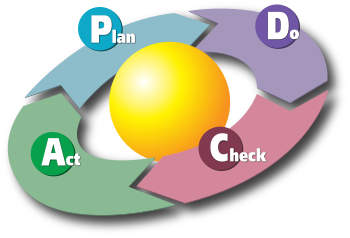
It is all cyclical. What goes around comes around... like karma. Right thought, right speech, right action. What I read in that journal reminded me of my initial teacher training, which was to consider learning as a four stage process and we should strive to improve and refine the experience, much in the way of agile development.

Deming Cycle, image under CC license Wikimedia
To be fair I think I am lucky because when I studied for my Postgraduate Certificate in Education in Applied ICT (Y7-14) at Sheffield Hallam University. I found my first placement school (Yewland's Technology College) provided excellent professional development. I went on to get my first teaching position there and I recall the Head presented a session on PDSA (Plan, Do, Study, Act) which is essentially a model of reflective practice which mirrors the Deming cycle.

Since this was one of my formative teacher training experiences I have found it to be an ingrained approach, one which I had (wrongly) assumed all teachers did as either a formal inquiry or at least as a thought exercise throughout their teaching practice.

Triadic Coaching

I was also fortunate to be involved in coaching triads which were non-hierarchical (e.g. not with a HoD or line manager so you would not be restricted by insecurities of an appraisal process) and involved teaming up with staff from other departments (even admin) who non-judgmentally observed my lesson with a co-constructed aim and helped facilitate reflective practice by only offering questions rather than comments or judgments, this helped us to question our own assumptions with the benefit of an impartial observer's 'other' perspective. For example, I may have been initially overly self-critical of the success of a lesson by focusing on the negative behaviour of one or two students but the buddy would ask, "how many students were on task at that point?" which would help to direct your reflection to other areas of success, or they may ask, "how did you feel at that point and how could you deal with that differently in the future". This essentially mirrors Gibb's Reflective cycle (Gibbs, 1988) as described in the journal (p8, Finlay, L., 2008)


The Dark Side of Reflective Practice is tempting

"Come to the Dark side - we have cookies"
 licensed by CC from https://www.flickr.com/photos/zizzy/6900760165
I think that the comments on the dark side of reflective practice are substantively true. I have witnessed staff derisively avoid reflective discourse as irrelevant 'navel gazing' and to somewhat arrogantly dismiss the failures in their classroom as being merely the fault of the student or the student's circumstances. Their thinking follows the logic that they consider themselves as teachers to be powerless to affect a changes. This failure to examine their own assumptions effectively disengages them from the whole process and they see their role to tell the student what to do and the student's to merely follow instructions.. I have also heard other staff use it as a blame game and a tick box routine. Thankfully there is "A New Hope" through teaching inquiries. 

I have used my HoD as a sounding board for the solitary reflections I have done in response to student feedback, observation and results data and my suggestions in how to improve the course have largely been agreed upon and actioned. We have brought about systemic change that has gone through multiple iterations of PDSA.

References

Finlay, L. (2008). Reflecting on ‘Reflective practice’. Open University, Practice-based professional learning centre. Retrieved June 16, 2015, from http://www.open.ac.uk/opencetl/files/opencetl/file/ecms/web-content/Finlay-%282008%29-Reflecting-on-reflective-practice-PBPL-paper-52.pdf

Activity 2 - Reflective Practice

Aluminum coated beam splitter. wikimedia (Zaereth 2011)


Reflection on my last 24 weeks of study. 

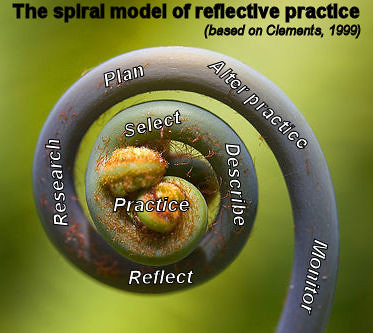
The spiral model of reflective practice
(based on Clements, 1999). Image CC from Flickr
(Soma, 2009)
I have really enjoyed this course. To be fair the course design was covering many of the topics I was already interested in, however, in doing this course I have researched the theory behind them and feel I can back them up as evidence-based practice, rather just a hunch.

Three things you have learned about yourself as a learner (metacognitive process)

I used to see my perfectionism as a strength, however, now I see it as a challenge to overcome. I struggled to accept work that was not polished and refined so I did not enjoy the short time constraints of collaborative class activities because for me the satisfaction was not in the completion, but it completing a piece to a high standard. This has been difficult for me to adjust to in terms of 'just in time" teaching or handing in work (even in a rough state) was better than not handing it in. These last two assignments are testament to this.
 

I now consciously adopt Carol Dweck's "growth mindset" (Dweck, 2013) in order to accept my failings as temporary setbacks rather than summative confirmations of 'talent' or lack thereof. I believe I can learn just about anything with enough resources, time and focus. I am enjoying learning things like Arduino which I used to consider 'too hard'.

I realised that I was on the right lines with my experiments with blended learning and flipped learning models. I can now more effectively use online learning resources such as CodeCademy or CodeAvengers.com in my teaching and have strategies to use summative quizes to guage learners progress. I also realise that whilst I like to learn visually from a wide range of resources, much like a sketch artist or watercolourist painter who uses broad brush strokes to get the big picture and iteratively build in detail. I realise that that doesn't work for others who may feel over whelmed by too much information if there is an embarrassment of riches from too many possible sources.

I realise the need to apply UDL (Universal Design for Learning) principles as digital natives are not lazy but lack attentions spans from the overwhelming abundance of information in the digital realm and social media. Multi-tasking is a coping mechanism. I have learnt that it is not terribly effective and I need to monotask and set myself personal Kanbans to work through tasks,


Three key changes in your own practice:

I no longer feel that I must be the "Sage on the Stage". I am prepared to learn from the students too - akonga can teach / learn together. I am better able to facilitate rather than teach. To pose questions rather than supply answers. I can emotionally deal with lack of certainty and feel happier seeing the students struggle and fail. 

In order to better manage the students' learning I am using data from online teacher dashboards like in Code.org so that I can help those who are trying to fly under the radar. I have encourage students to enter competitions such as the IITPTechHub  & RSNZ CREST Team Bronze Awards.

I have encouraged 20% time, student agency and choice of projects and encouraged peer programming and project based learning and teamwork.

I have adopted agile methods with frequent customer feedback (with pivots if necessary) rather than a strict waterfall approach to planning the curriculum. I used to use Design Thinking through an ADDIE approach, however the waterfall method meant there was no going back and reflection at the end of the teaching learning was too late for changes in the current cohort's experience.

Creative Commons - Flickr from http://www.speedofcreativity.org (Hinckley, 2014)
I encourage students to persevere. I used to see this as essentially a question of character or lack of gumption. I used to think students were too often predisposed to give up. But now I see it is important for me as the teacher to model the framing of failure as an important step in the process.

I now actively encourage the F.A.I.L. acronym: First Attempts In Learning. I also encourage more Constructivist exploratory learning rather than teaching and lecturing. However, I don't think that this works for all students for deep and detailed content (infinite failure and barking up the wrong tree is wasteful of resources - not everyone is an autodidact) unless it is carefully guided scaffolded.

I have reflected that the key to good teaching is more than just subject knowledge it is also knowledge of your students and having positive relations with them. It is summed up nicely in this blog: http://www.speedofcreativity.org/2015/11/26/students-need-teacher-relationships-not-just-adaptive-software-videos/ which posits that KhanAcademy.org algorithms alone cannot replace teachers because as social creatures we need socialisation in education.

References:
Hinckley, G.B. August 29, 2014. You have not failed until you quit trying. Retrieved from https://www.flickr.com/photos/pictoquotes/15036483126
Soma, D.J. OCtober 20, 2009. Reflective Practice Spiral. Retrieved from https://www.flickr.com/photos/43413412@N03/4031039030
Zaereth, March 23, 2011.  "Flat metal-coated beamsplitter" - Own work. Licensed under CC0 via Commons - Retrieved from https://commons.wikimedia.org/wiki/File:Flat_metal-coated_beamsplitter.png#/media/File:Flat_metal-coated_beamsplitter.png

Sunday, November 29, 2015

APC - Reflective Journal - Activity 1 - Welcome

Kia Ora,

And welcome back. This blog has been silent for some time because I had stopped using Blogger in my classrooms, in favour of Google Sites and then as a school we switched to Moodle, and most recently Google Classroom (like Moodle lite) to keep students up to date with what was happening in my classroom. A lots has changed in that time.

Perhaps switching platforms is partly due to each platforms' technological evolution (or built-in obsolescence) but it seems like a good time to dust off the old blog and start afresh. I switched back to blogger for my Postgraduate Certificate in Applied Practice (Digital and Collaborative Learning) with The Mind Lab by Unitec because it has good analytic data (so I am told). 

short introduction - who am I

My name is Matt Harrison. I am a specialist ICT / Digital Technology teacher. I was trained in the UK. I worked in the IT industry for 7 years in a variety of roles such as a graphic designer, web developer and chief sub-editor. I've taught for 10 years now in the UK and NZ. I am happily married and have four great kids aged 4, 6, 15 and 18.


What I teach 

I have taught high school (Y7-14)  ICT, Media Studies, Graphic Design, Mathematics, Digital Technology (including Computer Science, Programming, Digital Information and Digital Media). I am an IT Leader/Mentor and have been responsible for training staff.


Own picture. I enjoy teaching adults and students.
This whanau was learning to code robots with sensors so they follow the black line. 
I have recently changed roles and I now work for The Mind Lab by Unitec as an EdTech Educator. This involves teaching students and teachers: coding, robotics, Arduino, LittleBits electronics, stop motion and 2D/3D animation, film making, games design and 3D design and printing. The students' ages range from K-12. 

Overview of my teaching approach/style. 

I have experimented with a range of flipped classrooms styles and for  project based learning and think that student centered blended learning models work effectively and are the most fun when they have student agency and co-constructed learning tasks. I am learning to say less and let them do more. I am also learning that I don't have to know everything (although I have worked really hard to upskill).


What am interested in or inspired by.

Inpired by Kung Fu Panda & Jack Black
I studied Lau Gar Kung Fu and Kickbooxing at the Sheffield Academy of Martial Arts for about 6 years and earned a Brown sash (junior instructor grade). Had I stayed in the UK I would have continued to black sash but there are no BFKA clubs in NZ. I've visited many different clubs and have found one locally so I can continue.

I am inspired by The Hour of Code Code.org and EdX.org and how learning to code is like painting, poetry and art all rolled into one.

I am inspired my my family and whanau who continually surprise and impress me.

References:

Arduino course:  https://opensourcehardwaregroup.com/thearduinocourse/ 
Generation Bass. November 28, 2007. Kung Fu Panda. Retrieved from https://www.flickr.com/photos/generationbass/5051722203