Monday, November 30, 2015

Activity 3 - Reaction to Linda Finley's "Reflecting on ‘Reflective practice’ "


Droste mirror effect - https://commons.wikimedia.org/wiki/File:A_mirror_Droste_effect_20140211181417.jpg


Recursion: my reflection on her reflection on 'reflective practice'

It is all cyclical. What goes around comes around... like karma. Right thought, right speech, right action. What I read in that journal reminded me of my initial teacher training, which was to consider learning as a four stage process and we should strive to improve and refine the experience, much in the way of agile development.
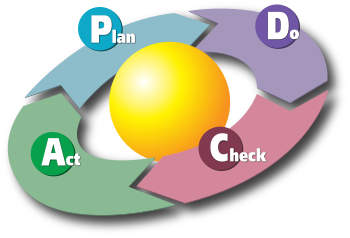
Deming Cycle, image under CC license Wikimedia
To be fair I think I am lucky because when I studied for my Postgraduate Certificate in Education in Applied ICT (Y7-14) at Sheffield Hallam University. I found my first placement school (Yewland's Technology College) provided excellent professional development. I went on to get my first teaching position there and I recall the Head presented a session on PDSA (Plan, Do, Study, Act) which is essentially a model of reflective practice which mirrors the Deming cycle.

Since this was one of my formative teacher training experiences I have found it to be an ingrained approach, one which I had (wrongly) assumed all teachers did as either a formal inquiry or at least as a thought exercise throughout their teaching practice.

Triadic Coaching

I was also fortunate to be involved in coaching triads which were non-hierarchical (e.g. not with a HoD or line manager so you would not be restricted by insecurities of an appraisal process) and involved teaming up with staff from other departments (even admin) who non-judgmentally observed my lesson with a co-constructed aim and helped facilitate reflective practice by only offering questions rather than comments or judgments, this helped us to question our own assumptions with the benefit of an impartial observer's 'other' perspective. For example, I may have been initially overly self-critical of the success of a lesson by focusing on the negative behaviour of one or two students but the buddy would ask, "how many students were on task at that point?" which would help to direct your reflection to other areas of success, or they may ask, "how did you feel at that point and how could you deal with that differently in the future". This essentially mirrors Gibb's Reflective cycle (Gibbs, 1988) as described in the journal (p8, Finlay, L., 2008)


The Dark Side of Reflective Practice is tempting

"Come to the Dark side - we have cookies"
 licensed by CC from https://www.flickr.com/photos/zizzy/6900760165
I think that the comments on the dark side of reflective practice are substantively true. I have witnessed staff derisively avoid reflective discourse as irrelevant 'navel gazing' and to somewhat arrogantly dismiss the failures in their classroom as being merely the fault of the student or the student's circumstances. Their thinking follows the logic that they consider themselves as teachers to be powerless to affect a changes. This failure to examine their own assumptions effectively disengages them from the whole process and they see their role to tell the student what to do and the student's to merely follow instructions.. I have also heard other staff use it as a blame game and a tick box routine. Thankfully there is "A New Hope" through teaching inquiries. 

I have used my HoD as a sounding board for the solitary reflections I have done in response to student feedback, observation and results data and my suggestions in how to improve the course have largely been agreed upon and actioned. We have brought about systemic change that has gone through multiple iterations of PDSA.

References

Finlay, L. (2008). Reflecting on ‘Reflective practice’. Open University, Practice-based professional learning centre. Retrieved June 16, 2015, from http://www.open.ac.uk/opencetl/files/opencetl/file/ecms/web-content/Finlay-%282008%29-Reflecting-on-reflective-practice-PBPL-paper-52.pdf

Activity 2 - Reflective Practice

Aluminum coated beam splitter. wikimedia (Zaereth 2011)


Reflection on my last 24 weeks of study. 

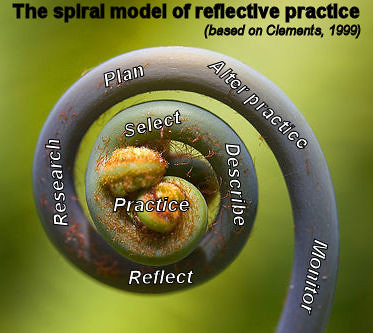
The spiral model of reflective practice
(based on Clements, 1999). Image CC from Flickr
(Soma, 2009)
I have really enjoyed this course. To be fair the course design was covering many of the topics I was already interested in, however, in doing this course I have researched the theory behind them and feel I can back them up as evidence-based practice, rather just a hunch.

Three things you have learned about yourself as a learner (metacognitive process)

I used to see my perfectionism as a strength, however, now I see it as a challenge to overcome. I struggled to accept work that was not polished and refined so I did not enjoy the short time constraints of collaborative class activities because for me the satisfaction was not in the completion, but it completing a piece to a high standard. This has been difficult for me to adjust to in terms of 'just in time" teaching or handing in work (even in a rough state) was better than not handing it in. These last two assignments are testament to this.
 

I now consciously adopt Carol Dweck's "growth mindset" (Dweck, 2013) in order to accept my failings as temporary setbacks rather than summative confirmations of 'talent' or lack thereof. I believe I can learn just about anything with enough resources, time and focus. I am enjoying learning things like Arduino which I used to consider 'too hard'.

I realised that I was on the right lines with my experiments with blended learning and flipped learning models. I can now more effectively use online learning resources such as CodeCademy or CodeAvengers.com in my teaching and have strategies to use summative quizes to guage learners progress. I also realise that whilst I like to learn visually from a wide range of resources, much like a sketch artist or watercolourist painter who uses broad brush strokes to get the big picture and iteratively build in detail. I realise that that doesn't work for others who may feel over whelmed by too much information if there is an embarrassment of riches from too many possible sources.

I realise the need to apply UDL (Universal Design for Learning) principles as digital natives are not lazy but lack attentions spans from the overwhelming abundance of information in the digital realm and social media. Multi-tasking is a coping mechanism. I have learnt that it is not terribly effective and I need to monotask and set myself personal Kanbans to work through tasks,


Three key changes in your own practice:

I no longer feel that I must be the "Sage on the Stage". I am prepared to learn from the students too - akonga can teach / learn together. I am better able to facilitate rather than teach. To pose questions rather than supply answers. I can emotionally deal with lack of certainty and feel happier seeing the students struggle and fail. 

In order to better manage the students' learning I am using data from online teacher dashboards like in Code.org so that I can help those who are trying to fly under the radar. I have encourage students to enter competitions such as the IITPTechHub  & RSNZ CREST Team Bronze Awards.

I have encouraged 20% time, student agency and choice of projects and encouraged peer programming and project based learning and teamwork.

I have adopted agile methods with frequent customer feedback (with pivots if necessary) rather than a strict waterfall approach to planning the curriculum. I used to use Design Thinking through an ADDIE approach, however the waterfall method meant there was no going back and reflection at the end of the teaching learning was too late for changes in the current cohort's experience.

Creative Commons - Flickr from http://www.speedofcreativity.org (Hinckley, 2014)
I encourage students to persevere. I used to see this as essentially a question of character or lack of gumption. I used to think students were too often predisposed to give up. But now I see it is important for me as the teacher to model the framing of failure as an important step in the process.

I now actively encourage the F.A.I.L. acronym: First Attempts In Learning. I also encourage more Constructivist exploratory learning rather than teaching and lecturing. However, I don't think that this works for all students for deep and detailed content (infinite failure and barking up the wrong tree is wasteful of resources - not everyone is an autodidact) unless it is carefully guided scaffolded.

I have reflected that the key to good teaching is more than just subject knowledge it is also knowledge of your students and having positive relations with them. It is summed up nicely in this blog: http://www.speedofcreativity.org/2015/11/26/students-need-teacher-relationships-not-just-adaptive-software-videos/ which posits that KhanAcademy.org algorithms alone cannot replace teachers because as social creatures we need socialisation in education.

References:
Hinckley, G.B. August 29, 2014. You have not failed until you quit trying. Retrieved from https://www.flickr.com/photos/pictoquotes/15036483126
Soma, D.J. OCtober 20, 2009. Reflective Practice Spiral. Retrieved from https://www.flickr.com/photos/43413412@N03/4031039030
Zaereth, March 23, 2011.  "Flat metal-coated beamsplitter" - Own work. Licensed under CC0 via Commons - Retrieved from https://commons.wikimedia.org/wiki/File:Flat_metal-coated_beamsplitter.png#/media/File:Flat_metal-coated_beamsplitter.png

Sunday, November 29, 2015

APC - Reflective Journal - Activity 1 - Welcome

Kia Ora,

And welcome back. This blog has been silent for some time because I had stopped using Blogger in my classrooms, in favour of Google Sites and then as a school we switched to Moodle, and most recently Google Classroom (like Moodle lite) to keep students up to date with what was happening in my classroom. A lots has changed in that time.

Perhaps switching platforms is partly due to each platforms' technological evolution (or built-in obsolescence) but it seems like a good time to dust off the old blog and start afresh. I switched back to blogger for my Postgraduate Certificate in Applied Practice (Digital and Collaborative Learning) with The Mind Lab by Unitec because it has good analytic data (so I am told). 

short introduction - who am I

My name is Matt Harrison. I am a specialist ICT / Digital Technology teacher. I was trained in the UK. I worked in the IT industry for 7 years in a variety of roles such as a graphic designer, web developer and chief sub-editor. I've taught for 10 years now in the UK and NZ. I am happily married and have four great kids aged 4, 6, 15 and 18.


What I teach 

I have taught high school (Y7-14)  ICT, Media Studies, Graphic Design, Mathematics, Digital Technology (including Computer Science, Programming, Digital Information and Digital Media). I am an IT Leader/Mentor and have been responsible for training staff.


Own picture. I enjoy teaching adults and students.
This whanau was learning to code robots with sensors so they follow the black line. 
I have recently changed roles and I now work for The Mind Lab by Unitec as an EdTech Educator. This involves teaching students and teachers: coding, robotics, Arduino, LittleBits electronics, stop motion and 2D/3D animation, film making, games design and 3D design and printing. The students' ages range from K-12. 

Overview of my teaching approach/style. 

I have experimented with a range of flipped classrooms styles and for  project based learning and think that student centered blended learning models work effectively and are the most fun when they have student agency and co-constructed learning tasks. I am learning to say less and let them do more. I am also learning that I don't have to know everything (although I have worked really hard to upskill).


What am interested in or inspired by.

Inpired by Kung Fu Panda & Jack Black
I studied Lau Gar Kung Fu and Kickbooxing at the Sheffield Academy of Martial Arts for about 6 years and earned a Brown sash (junior instructor grade). Had I stayed in the UK I would have continued to black sash but there are no BFKA clubs in NZ. I've visited many different clubs and have found one locally so I can continue.

I am inspired by The Hour of Code Code.org and EdX.org and how learning to code is like painting, poetry and art all rolled into one.

I am inspired my my family and whanau who continually surprise and impress me.

References:

Arduino course:  https://opensourcehardwaregroup.com/thearduinocourse/ 
Generation Bass. November 28, 2007. Kung Fu Panda. Retrieved from https://www.flickr.com/photos/generationbass/5051722203

Tuesday, September 1, 2015

Follow other Blogs

Add other Blogs to follow them:


Please add:


If you find other good blogs about Games Design then please share them with the class.

Games Design Project

Get Blogging:


You can use the skills were have learnt so far to make your own game, animation or quiz (in a team):


You could make your game on a new platform like:

Follow & Share

Make a blog on Blogger.com to show your plans and progress and share your ideas as they develop,
Email me (and your classmates) the link to your blog via mharrison@sbc.school.nz


cheers
Mr Harrison

Monday, April 26, 2010

L2 Word Processing - US111

This is essential revision for the Resubmission of US111 - worth 5 credits.


THIS WEEK’S WORK:

Students should create A4 posters & cheat sheets (How to guides) to clearly explain:


a) Definitons of 4x keywords (word processing terminology), e.g. document retrieval, key principle of naming files, how & why to organize folders, what is a word processing

b) Describe 2x word processing FORMATTING
techniques, e.g. paragraph alignment, bullet points / numbered lists / changing font styles

c) Describe 2x word processing EDITING
techniques, e.g. Find/Replace, Spelling/Grammar check, insert automatic page numbers into the footer.

[NB Answers may use pictures / icons / screenshots but SHOULD CLEARLY SHOW USERS HOW TO DO THE ABOVE in sentences using specific accurate terms, e.g. naming the Standard / Formatting or Drawing Toolbars.]


More information is available on the Word Processing page of the SBC ICT class website: http://sites.google.com/a/sbcschool.com/ict/home/computing/word-processing

Homework / Extension Work:


Either use Word / Open Office or your Google Docs to complete the revision, tasks and assessments on http://www.reviseict.co.uk/lessons/word/


Tuesday, April 20, 2010

L2 COM - Health & Safety Booklet

All level 2 Com students should complete the Health & Safety booklet by Friday of Week 1.

Next, design a poster for OSH on ergonomics.
This is a class competition. The best posters will be printed A3 in colour for wall.


Go to http://sites.google.com/a/sbcschool.com/ict/home/computing/word-processing for more information.

The booklet is at: http://sites.google.com/a/sbcschool.com/ict/home/computing/word-processing/Health_Safety_worksheet.doc?attredirects=0&d=1

The info to find is at: http://www.teach-ict.com/ecdl/module_1/workbook14/miniweb/index.htm